Description
Stop hearing “everyone in this book sounds the same.”
The single most common complaint authors hear — especially on AI-assisted books — is that every character sounds identical and the story feels flat. Beta readers say it. Editors say it. Reviews say it. And you can’t see it yourself because you’re too close to the prose.
Voice Doctor is the Claude plug-in that makes flat character voices visible and fixable. It diagnoses exactly where voices are blending together, prescribes specific fixes, and rewrites the flagged passages for you — with every plot beat, name, scene outcome, POV, tense, genre, and heat level absolutely preserved.
What you get
- 3 specialized skills — voice-bible-builder, voice-auditor, voice-rewriter
- 4 slash commands —
/voice-bible,/voice-audit,/voice-fix,/voice-pipeline - 1 end-to-end pipeline — bible → audit → rewrite → re-audit, all in one command
- A 19-page install & user manual with two worked examples and a sample voice bible excerpt
How it works
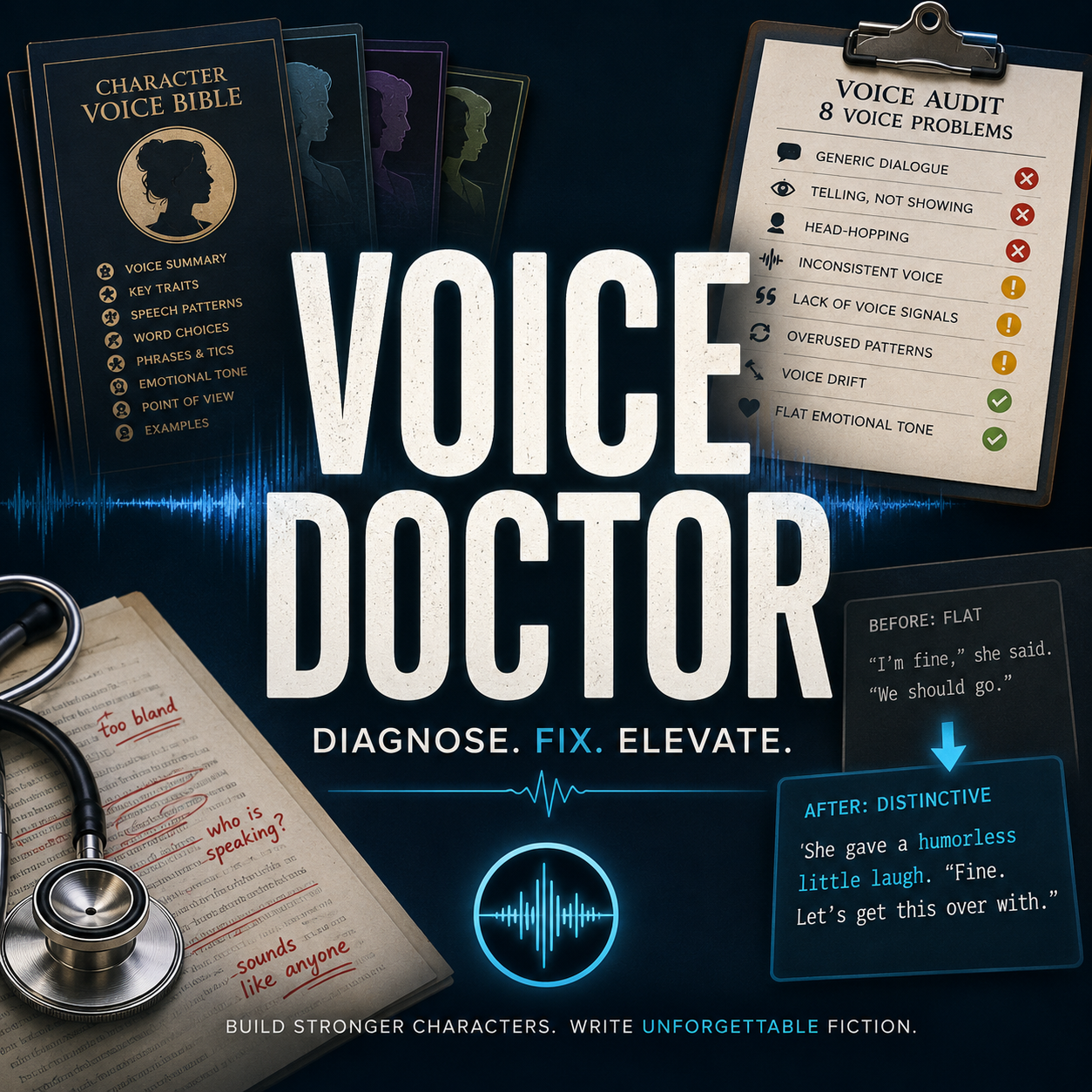
1. Build the voice bible. Voice Doctor profiles every named character across 12 dimensions of fiction voice — identity, idiolect, sentence architecture, rhythm, register, dialect markers, profanity threshold, hedges, subtext habits, metaphor wells, emotional default, body signature, and (for POV characters) internal monologue. Plus a fingerprint sentence (“only this character would say this”) and an anti-voice sentence (“this character would never say this”).
2. Audit the manuscript. Voice Doctor runs 8 named tests against your book:
- Anonymous Dialogue Test — can dialogue be attributed without tags?
- Witty Saturation — is too much of the cast in the same sardonic register?
- Shared Speech Tics — are hedges colliding across characters?
- Generic Internal Monologue — does POV reflect the character or sound like generic narration?
- Metaphor Wells — are characters reaching for the same imagery?
- Flat Emotional Register — do characters sound different in fight vs tender vs neutral scenes?
- Missing Subtext — is everyone saying exactly what they mean?
- Body Signature — do characters have distinct physical tells?
You get a composite Voice Differentiation Score (0–100), a severity verdict (STRONG / SOFT / WEAK / SEVERE / FLAT), per-character voice strength cards, every flagged passage with chapter and verbatim quote, and a prioritized fix list.
3. Fix the flagged passages. The rewriter applies the voice bible to every flagged passage at one of 5 aggression levels — from light polish (~95% of your prose preserved) to heavy injection (~30% preserved, 100% plot preserved). Every change appears in a side-by-side diff document so you can accept, reject, or edit individual rewrites.
4. Verify the fix worked. Voice Doctor re-audits the revised manuscript and compares scores. If the Voice Differentiation Score didn’t rise by at least 15 points, it recommends a higher aggression level.
What’s preserved — absolutely
The rewriter never alters plot beats, scene outcomes, information conveyed, character actions or decisions, names of people or places, POV, tense, chapter structure, scene order, genre conventions, or romance heat level. Sweet stays sweet. Scorching stays scorching. Only voice changes.
Works on any fiction genre
Cozy mystery, romance (any heat level and configuration — MF, MM, FF, multi), fantasy, sci-fi, thriller, horror, literary, MG/YA. Genre-agnostic by design. Use it after drafting to retrofit voices onto a flat manuscript, or build the bible upfront so your drafting (yours or another AI tool’s) produces differentiated voices from the start.
Inputs and outputs
- Input: Your manuscript in .docx, .epub, or .txt (.docx preferred) — plus, optionally, a character bio or codex document.
- Outputs: Voice Bible .docx, voice-profiles.json, audit report .docx, audit-report.json, revised manuscript .docx, diff document .docx, rewrite-manifest.json.
What’s included in this purchase
voice-doctor.pluginfile — drag-and-drop install into Claude Desktop (Cowork mode) or one-line install in Claude Code- Voice Doctor — Install & User Manual (PDF, 19 pages) covering installation, every command and skill, two worked examples (retrofitting a flat manuscript + building voice upfront), a sample voice bible character profile, troubleshooting, and FAQ
- Genre-agnostic — works on every book you write, forever
- Single-user commercial use license (use it on every book you publish under any pen name you own)
System requirements
Claude account (Pro, Max, or Team recommended). Claude Desktop with Cowork mode enabled, or Claude Code CLI. A workspace folder on your computer where output files land. That’s it.
Why this exists
Most AI writing tools are great at producing prose and terrible at giving each character a distinct voice. The result is a draft where the heroine, her best friend, the love interest, and the villain all sound like the same person wearing different hats. Voice Doctor is the editorial layer that fixes that — without you having to rewrite the book yourself, and without changing a single plot point.
One purchase. Every book you ever write. Forever.
Premium members of the AI Writing Easy AF for Authors community have access to this plugin included with their membership. →